
Explaining the Unseen: Interactive 3D Animation for Complex Industrial Processes
A touch-screen based animation keeps users engaged, and consequently they spend longer times with the sales team.
When a technology exists in places people cannot easily see, traditional video has limitations.
This challenge is common across industries such as energy, manufacturing, aerospace, medical devices, and industrial equipment. The more technical the subject matter becomes, the harder it is to communicate through conventional photography or video alone.
Recently, our team at Nashbox Studios worked with Deep Isolation to create an interactive visualization experience for use at trade shows, investor presentations, and sales meetings. The project highlighted a challenge we encounter frequently: how do you explain a highly technical process that takes place thousands of feet underground?
The Challenge of Visualizing the Invisible
Interactive animations are beneficial for complex industrial processes that occur in difficult to film places, such as drilling beneath the earth’s surface.
Deep Isolation's technology focuses on the long-term disposal of used nuclear fuel. The process begins at a nuclear facility and continues through a series of carefully controlled steps that ultimately place specialized storage canisters deep underground within engineered boreholes. Once emplaced, the system is designed to safely isolate the material for the long term.
The challenge was not simply explaining the process. The challenge was making it understandable.
There is no practical way to film much of the emplacement process. Key stages occur underground, involve highly specialized equipment, or represent future operational scenarios that do not yet exist as physical installations available for filming.
Traditional video alone would have required viewers to watch a linear sequence and absorb a large amount of technical information in a short period of time. For audiences such as government agencies, nuclear industry professionals, and investors, that approach often creates more questions than answers.
Why Interactive Experiences Work
Rather than creating a passive video presentation, we developed an interactive experience that allows viewers to explore the process step by step.
The experience follows the journey of used nuclear fuel from extraction at a nuclear power plant through transportation, emplacement, and long-term monitoring. Visitors can navigate through the process at their own pace, spending more time on the stages that interest them most.
The interactive experience covers key phases including:
Extraction from the nuclear facility
Transfer into specialized canisters
Placement within Repository Shielded Overpacks (RSOs)
Transportation to storage and wellhead locations
Borehole drilling operations
Canister retrieval and emplacement
Post-closure monitoring
By allowing users to control the experience, complex information becomes easier to absorb and understand.
Building a Digital Environment from Scratch, with the help of AI
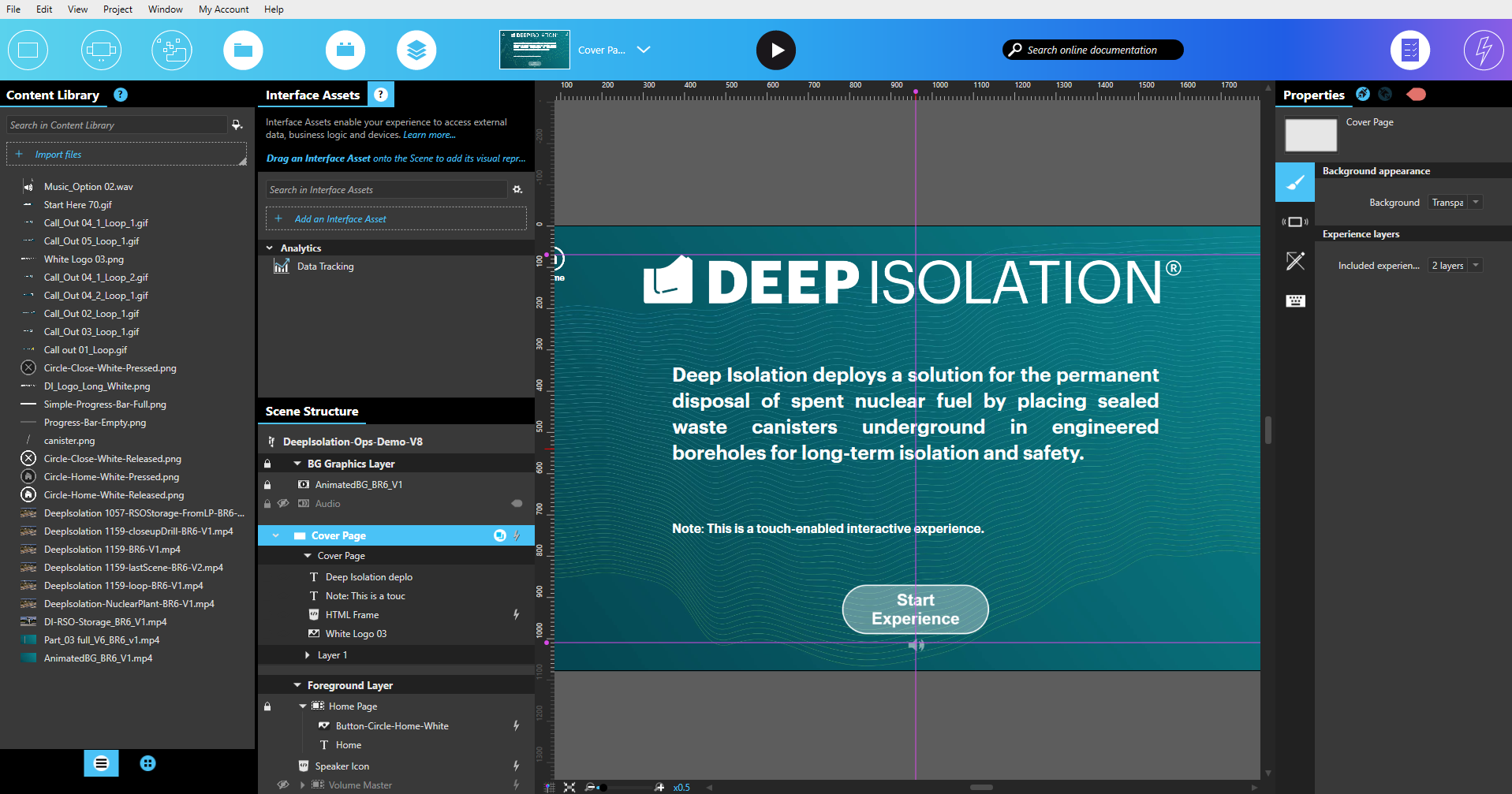
We used Intuiface along with traditional tools like Premier Pro and AI tools such as ChatGPT to greatly improve the efficiencies of our processes.
One of the most interesting aspects of the project was that very little source material existed in a format suitable for visualization.
Deep Isolation provided technical documentation, engineering references, and supporting imagery. Using these materials, our team developed custom visual assets to recreate equipment, environments, transportation systems, and underground infrastructure. The goal was not simply to create attractive visuals. Accuracy was critical. Every stage of the experience needed to communicate the process clearly while remaining faithful to the underlying engineering concepts.
To accelerate development, we incorporated AI-assisted tools throughout the project. AI helped generate portions of the code used within the interactive experience, assisted with graphic development, and allowed our team to rapidly prototype ideas. Combined with traditional design, animation, and development workflows, these tools helped us move from concept to deployment more efficiently while maintaining technical accuracy.
The result was a visual environment capable of showing locations and operations that would otherwise be impossible for audiences to see.
Interactive Content Creates Better Conversations
One of the biggest advantages of interactive visualization is that it transforms presentations into conversations. At a trade show, visitors rarely consume information in a linear fashion. They ask questions. They jump between topics. They focus on the areas most relevant to their interests.
Interactive experiences support this natural behavior. Instead of forcing viewers through a fixed presentation, presenters can immediately navigate to a specific stage of the process, answer questions in real time, and provide deeper context where needed. This flexibility is particularly valuable when communicating with technical audiences, regulators, investors, and decision makers.
Beyond Nuclear Energy
Although this project focused on nuclear waste disposal, the underlying communication challenge exists across many industries.
Manufacturers need to explain internal product mechanisms.
Energy companies need to communicate infrastructure projects.
Medical device companies need to demonstrate procedures that occur inside the human body.
Technology companies need to visualize processes that exist entirely within software.
In each case, interactive visualization can provide a clearer and more engaging alternative to traditional presentations.
The Entire Presentation
The entire presentation is about 6 minutes long, and may run longer depending upon how effectively users engage with it. Deep Isolation successfully deployed it at multiple trade shows and received an overwhelmingly positive response. The next phase of development will involve diving deeper into the process of extraction of waste fuel from nuclear plants, types of waste fuels and corresponding cannister designs and detailed post closure metrics.
———
At Nashbox Studios, we specialize in industrial 3D animation. We've helped energy companies explain complex technologies to investors, clients, and the public.